

The publication of the Milburn Review this week should prompt a practical conversation around every boardroom and in every council chamber across Surrey and the Thames Valley. And the question I think is most pressing off the back of Milburn’s findings is, how will we make the opportunities in our region accessible to the young people growing up here?

And the question I think is most pressing off the back of Milburn’s findings is, how will we make the opportunities in our region accessible to the young people growing up here?
For Activate Learning, this question is central to what it means to us to be an anchor partner. Our eight colleges belong within that conversation because education connects the ambitions of young people with the future of their communities.
The Office for National Statistics estimates that 981,000 people aged 16-24 were not in education, employment or training in April to June 2026, equivalent to 13% of that age group. These are UK figures, rather than a measure of our own region, and the ONS advises caution over short-term movements. Even with that qualification, the scale of young talent outside learning and work should concern every organisation planning its future workforce.
Milburn proposes an ambition to reduce that rate to around 5% by 2036, supported by locally coordinated opportunities and practical help. While I recognise those are recommendations, with decisions on implementation still ahead, they give civic and business leaders an immediate reason to examine how effectively our existing institutions work together. We need to begin improving relationships and routes into opportunity while national policy develops.

An anchor partner accepts a lasting responsibility to its place, a clear commitment set out in the term used to define us. Our Extraordinary Learning strategy commits Activate Learning to education and training that meet local and national skills needs, working with employers and civic partners. Our colleges bring technical education, apprenticeships, higher education and routes back into learning into those relationships. Their value lies in helping someone find an appropriate starting point and a viable next step, including when their original plan has broken down. This is a role that colleges take on willingly and with great pride.
Regional prosperity does not make that responsibility disappear. Surrey’s new Local Skills Improvement Plan describes a highly skilled economy that still needs clearer pathways for young people and economically inactive residents. Its priorities include engineering, construction, health and care, and digital capability. In the Thames Valley, the Chamber of Commerce’s new Skills Commission has explicitly included action on young people outside education and work within its remit. The foundations for a shared response are already taking shape, we simply need to give them momentum.
For employers, the most useful partnership with a college starts before a vacancy becomes urgent. Sharing plans for investment, changing technologies and future occupations helps us shape relevant provision. Offering workplace experience gives young people a more informed understanding of a career and gives employers a chance to recognise potential. A young person who has never encountered an industry cannot be expected to understand its opportunities simply because those opportunities exist nearby.
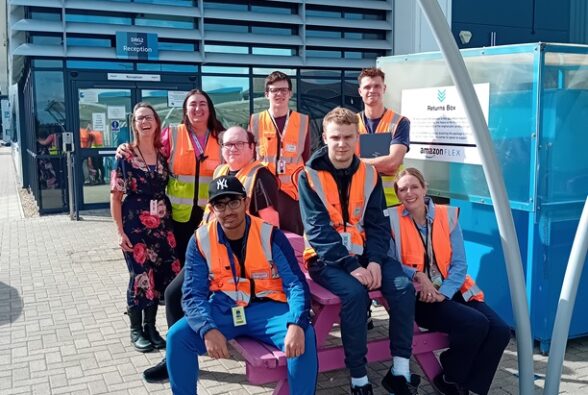
We also need routes that reflect different needs. The supported internship partnership at Amazon Theale brings together Activate Learning, Amazon, DFN Project SEARCH and Ways into Work. College teaching is combined with workplace rotations and specialist job coaching for young people with special educational needs and disabilities. This is a distinct pathway from an apprenticeship. It illustrates how education, employer commitment and specialist support can be organised around the same person, with each partner contributing something the others cannot provide alone.
Our Learning Philosophy helps explain how we approach that work. We want learners to feel safe, find purpose and make progress and for a young person returning after a difficult experience of education, that means being listened to, understanding how learning relates to their ambitions and being able to recognise improvement.
High expectations need to be accompanied by consistent support, and we’ve seen across our colleges how confidence grows through opportunities to practise and succeed, with people on hand to help when something goes wrong.
However, that support cannot sit entirely within education. A course offer will not resolve an inaccessible bus journey, unstable housing or a need for specialist health care, which is where civic partners have an essential role in making participation possible.
Whatever decisions ministers take on the review’s welfare proposals, I would judge their success by whether young people can access suitable opportunities with the support and financial security their circumstances require. Disabled young people must have their ambitions taken seriously, alongside recognition of their individual needs.
I would like our regional response to become much more specific, with employers identifying the entry opportunities they could offer over the coming year and the support that would make those offers viable. Colleges should work with them on the learning and preparation required. Councils, health partners and community organisations should agree how they will help young people reach and sustain those opportunities. Young people themselves need a voice in that planning, including those who have disengaged from services.
The shared test should extend beyond an enrolment or a first day at work. We should ask whether someone is still participating months later, whether their skills are developing and whether there is a route onwards. When a placement or course ends unexpectedly, there should be an agreed way to reconnect them with support. That is where a regional partnership earns the trust of the people it serves.
Activate Learning has a clear contribution to make through all eight colleges and the relationships around them. My invitation to civic and business leaders across Surrey and the Thames Valley is to work with us on the opportunities young people can actually take up. Bring us your workforce plans, the barriers you encounter and your willingness to offer a first chance, and we will provide you with the skilled young people to meet your needs.
